In 2007 a new optimization method appeared, inspired by water drops in rivers. Each drop carried soil and chose its path by the amount of soil on the paths ahead, eroding the paths it used. The "intelligent water drops" algorithm was applied to the traveling salesman problem and many others, and a literature of extensions grew around it. A little over a decade later, Camacho-Villalón, Dorigo, and Stützle (2019) showed that every one of its main components is a simplification or special case of a component of ant colony optimization, a method published years earlier, and that most of the ideas explored in its extensions had already been studied there. The rivers and the soil had added a vocabulary, not a method.
The same period produced a working antenna evolved by computer and flown in space, and evolution strategies that are routinely used to optimize difficult continuous functions. Both stories belong to evolutionary computation. This article separates what the biological metaphor contributes from what it obscures. It builds on natural selection for computer scientists, which sets out the biology an evolutionary algorithm (EA) borrows.
Natural selection is not an optimizer
Optimization means finding a point that makes a given objective function as large or as small as possible. Natural selection has no objective function. Lewontin's (1970) three conditions, variation, differential reproduction, and heritability, guarantee that a population changes. They say nothing about improvement toward any fixed target, for several reasons.
- Fitness is defined after the fact. In biology, fitness is the reproductive success a variant achieves in its environment (Futuyma and Kirkpatrick, 2017). It is not a score assigned in advance, and it is not stable: when the environment changes, including the other species and the rest of the population, a variant's fitness changes with it.
- Selection is local and short-sighted. It favors whatever leaves more descendants now. A change that would pay off only after several neutral or harmful intermediate steps is not selected for.
- Chance competes with selection. In finite populations, genetic drift fixes or loses alleles regardless of their effect on fitness when that effect is small, and much molecular change may be neutral (Kimura, 1968).
A familiar consequence is that well-adapted organisms carry obvious imperfections. Selection explains adaptation, but it does not imply optimality.
A worked example: selection that lowers mean fitness
When fitness values are fixed, selection does behave like an optimizer of one quantity. Natural selection for computer scientists derives that mean fitness then rises each generation by $\operatorname{Var}(w)/\bar w$, the variance in fitness divided by its mean. The derivation needs every type's fitness to stay the same as frequencies change. When fitness depends on what the rest of the population is doing, nothing guarantees a rise, and a small model shows mean fitness falling all the way to its minimum.
Take a large population of two heritable types. A cooperator pays a cost $c$ to produce a benefit $b$ that is shared at random over the whole population; a defector pays nothing and produces nothing. If $p$ is the frequency of cooperators, every individual receives $b\,p$, so
$$w_C = 1 + b\,p - c, \qquad w_D = 1 + b\,p, \qquad \bar w = p\, w_C + (1 - p)\, w_D = 1 + (b - c)\, p.$$
At every frequency a defector is fitter than a cooperator, by exactly $c$, so selection always favours defectors and $p$ falls toward 0. But mean fitness $1 + (b - c)p$ is largest when $p = 1$, everyone cooperating, as long as the benefit exceeds the cost. Selection drives the population to the point of lowest mean fitness.
With $b = 0.5$, $c = 0.1$ and 99% cooperators at the start, the recursion $p' = p\, w_C / \bar w$ gives the following (computed by tools/experiments/evolution/selection_not_optimizer.py, rounded to four decimals):
| Generation | Cooperators $p$ | $w_C$ | $w_D$ | Mean fitness $\bar w$ |
|---|---|---|---|---|
| 0 | 0.9900 | 1.3950 | 1.4950 | 1.3960 |
| 20 | 0.9610 | 1.3805 | 1.4805 | 1.3844 |
| 40 | 0.8566 | 1.3283 | 1.4283 | 1.3426 |
| 60 | 0.5667 | 1.1834 | 1.2834 | 1.2267 |
| 80 | 0.1831 | 0.9915 | 1.0915 | 1.0732 |
| 100 | 0.0291 | 0.9145 | 1.0145 | 1.0116 |
| 150 | 0.0002 | 0.9001 | 1.0001 | 1.0001 |
Cooperators fall below half in generation 64 and below 1% in generation 111, and mean fitness falls from 1.396 to 1.000. In the first generation the formula for fixed fitness values would predict a rise of $\operatorname{Var}(w)/\bar w \approx 0.00007$; mean fitness instead falls from 1.396000 to 1.395716, because the act of selecting changes everyone's fitness.
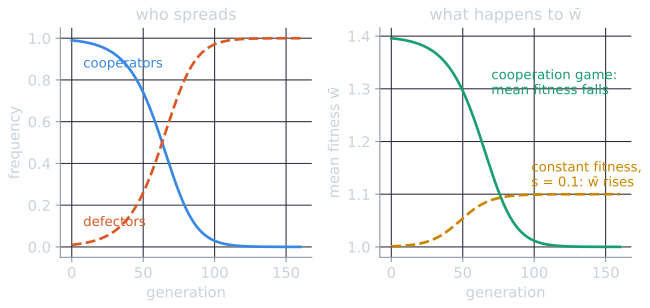
An EA designer facing this payoff structure would simply maximize $\bar w$ and set $p = 1$. Natural selection cannot, because it compares the types present against each other, generation by generation, rather than evaluating the population as a whole. A fixed fitness function of a single candidate, the defining choice of an EA, is what removes this gap.
An EA becomes an optimizer through choices that have no counterpart in nature. The designer writes a fitness function, holds it constant for the run, keeps the population size fixed, often preserves the best individual unchanged (elitism), and stops when a target is reached or a budget is spent. These choices are what make the result a solution to a stated problem. They also mean that EAs inherit drift and short-sightedness without inheriting the vast populations and timescales that let natural evolution produce complex adaptations. The drift experiment in the companion article shows the effect directly: with a population of 50 and no mutation, fitness-proportional selection on a 100-bit problem fixed a median of 30 bits at the wrong value over 30 runs.
A fitness function is a statement of intent
Because the fitness function replaces the environment, an EA optimizes exactly what it is told to, including any mistake in the telling. Lehman and colleagues (2020) collected many first-hand accounts of evolution exploiting a fitness measure. Two examples:
- Karl Sims measured the fitness of simulated creatures by their average ground speed over ten simulated seconds. Instead of walking, creatures evolved to be tall and rigid and to fall over, converting their initial potential energy into speed. The fix was a change to the evaluation, not to the algorithm.
- When the program-repair system GenProg was asked to fix a buggy sorting program, the tests checked that the output was in sorted order. GenProg found that a program returning an empty list passed, since an empty list is not out of order.
These are not failures of evolution. They are fitness functions working as written. The point generalizes to every optimizer, but it bites EAs especially hard because they need no model of the problem: whatever the fitness function does not penalize is permitted. The surprising creativity of digital evolution collects more cases.
Practical systems acknowledge this. In the ST5 antenna project, when the spacecraft's orbit changed, the team met the new requirements with "minimal changes" to its evolutionary system, "mostly in the fitness function" (Hornby, Globus, Linden, and Lohn, 2006). The authors of AlphaEvolve name its main limitation as applying only to problems for which an automated evaluator can be written (Novikov and colleagues, 2025). In both cases the evaluator is where the engineering knowledge lives.
Novelty by metaphor
The sharpest criticism of nature-inspired optimization comes from within the field. Sörensen (2015) argued that a growing stream of new metaheuristics, each based on a different natural or man-made metaphor, threatened to lead the field away from scientific rigor, and described what high-quality research on metaheuristics looks like instead. The algorithms in question include methods named after harmony, water drops, wolves, bats, fireflies, and many other things; most are not evolutionary in the narrow sense, but they share the pattern of presenting an optimizer through a story.
Several careful analyses then took individual methods apart:
- Weyland (2010) analyzed harmony search, a method presented as a model of musicians improvising, and showed that it is a special case of evolution strategies, a family introduced decades earlier.
- Camacho-Villalón, Dorigo, and Stützle (2019) showed, as described above, that the intelligent water drops algorithm is a particular instantiation of ant colony optimization, and judged its metaphor to be unnecessary and misleading.
- Camacho-Villalón, Dorigo, and Stützle (2023) decomposed six widely used algorithms, the grey wolf, moth-flame, whale, firefly, bat, and antlion optimizers, into components and matched each with equivalent components of particle swarm optimization and evolutionary algorithms. They concluded that the only novelty in the six was terminology derived from the metaphors.
Aranha and colleagues (2022) summarized the harm in an open letter signed by many researchers in the field. New terminology for known ideas confuses the literature and makes methods hard to compare. Metaphors are often oversimplified or modified until the mathematical model and the implementation have little to do with the inspiring phenomenon. Experimental comparisons are often against weak or outdated baselines. The letter asked editors to adopt a policy that some journals, including the Journal of Heuristics, Swarm Intelligence, and ACM Transactions on Evolutionary Learning and Optimization, had already adopted: no "novel" metaphor-based method should be published unless its authors describe it in standard optimization terminology, show that it brings useful new concepts, motivate the metaphor on a sound scientific basis, and compare it fairly with the state of the art.
The critique is not an argument against evolutionary computation. Evolution strategies, genetic algorithms, and ant colony optimization are the established baselines the critics measure new methods against, and several of the critics are leading researchers in those methods. It is an argument about what counts as a contribution: a mechanism stated precisely, and evidence that it helps on some class of problems. A biological story is neither.
No free lunch, and why structure matters
A common defense of yet another metaphor-based method invokes the No Free Lunch theorems. Wolpert and Macready (1997) proved that, averaged over all possible objective functions on a finite search space, every search algorithm that does not revisit points has the same performance distribution. Any advantage on one class of functions is paid for by a disadvantage on others. The defense runs: since no algorithm is best for everything, there is always room for a new one.
Camacho-Villalón, Dorigo, and Stützle (2023) call this rationale a wrong understanding of the theorems, noting among other things that the methods in question optimize continuous functions, a setting in which the theorems do not hold. Read correctly, the theorems say that performance comes from a match between an algorithm's assumptions and a problem's structure. They do not say that a new algorithm will find unexploited structure, and they give no reason to expect that a new metaphor encodes any. The constructive reading is the opposite of the defense. An EA works when its representation and operators make good solutions reachable by small, mostly improving steps, which is a statement about the fitness landscape the operators define. The useful question about any method, evolutionary or not, is what structure it exploits. The benchmarking literature reflects this: in the BBOB-2009 comparison of 31 algorithms on 24 noiseless continuous test functions, which algorithm was best depended strongly on the number of function evaluations available (Hansen, Auger, Ros, Finck, and Pošík, 2010).
Where evolutionary methods earn their place
The critique leaves a body of methods that are well understood, well tested, and in some areas the standard choice. Three examples span three decades.
CMA-ES. The covariance matrix adaptation evolution strategy (Hansen and Ostermeier, 2001) samples candidate solutions from a multivariate normal distribution and adapts the distribution's mean, step size, and covariance matrix from the successful samples. Hansen (2016) motivates its design from the requirements of search in continuous spaces, not from biology. On convex quadratic functions, learning the covariance matrix is analogous to learning the inverse Hessian in a quasi-Newton method. The algorithm is invariant to strictly increasing transformations of the objective and, given a matching initial state, to rotations and other linear transformations of the search space, which Hansen treats as a fundamental design criterion. He describes CMA-ES as an attractive option when gradient-based methods such as BFGS fail because the function is non-convex or rugged, with sharp bends, discontinuities, noise, or local optima. The word "evolution" survives in the name, but the method is stated, analyzed, and benchmarked in standard terms. CMA-ES has its own article.
The ST5 antenna. For NASA's Space Technology 5 mission, three small spacecraft, an evolutionary algorithm designed an X-band antenna of unusual, organic-looking shape. The search was constrained by engineers to a class of monopole wire antennas, and each design was scored by electromagnetic simulation against the mission's gain and voltage standing wave ratio requirements. The evolved antenna met the requirements, was tested at NASA Goddard Space Flight Center, and flew on the mission launched on 22 March 2006; its designers describe it as the first computer-evolved antenna deployed for any application. They report that it took about three person-months to design and fabricate, against about five for the conventionally designed antenna (Hornby, Globus, Linden, and Lohn, 2006; Hornby, Lohn, and Linden, 2011). Evolved designs in engineering covers this and similar cases.
AlphaEvolve. AlphaEvolve (Novikov and colleagues, 2025) runs an evolutionary loop over programs, with large language models proposing code changes and automated evaluators scoring the results. Its program database draws on two established ideas from the field, MAP-Elites and island-model populations. The authors report a scheduling heuristic for Google's data centers that recovers on average 0.7% of fleet-wide compute resources, and a procedure for multiplying two $4 \times 4$ complex-valued matrices with 48 scalar multiplications, an improvement on the 49 obtained by applying Strassen's algorithm recursively. AlphaEvolve and LLM-guided evolution describes the system.
The three share a profile. Each problem had an evaluator that was automatic and trusted (an objective function, an electromagnetic simulator, a program checker), a search space where gradients were unavailable or unhelpful, and a representation designed with knowledge of the domain. In each case the evolutionary loop is a search method that can be stated without biology, and its results were judged against independent standards, such as benchmark suites, mission requirements, and prior mathematical results.
What survives of the metaphor
The biological vocabulary remains useful as shorthand. "Population", "mutation", "crossover", and "selection" are compact names for well-defined operations, and the analogy to population genetics has supplied real tools, from drift and selection pressure to the fitness landscape. Biology has also been a productive source of questions, such as how diversity can be maintained, as in MAP-Elites and novelty search, and how a small genotype can encode a large structured phenotype, as in CPPNs.
The limit is that a metaphor is a reason to try an idea, not a reason to believe it works. Natural evolution has no objective, so nothing about an algorithm's success follows from its resemblance to evolution. What an EA does is determined by its representation, its operators, its selection scheme, and above all its fitness function, and it should be described, analyzed, and tested in those terms.
References
- Aranha, C., Camacho Villalón, C. L., Campelo, F., Dorigo, M., Ruiz, R., Sevaux, M., Sörensen, K., and Stützle, T. (2022). Metaphor-based metaheuristics, a call for action: the elephant in the room. Swarm Intelligence, 16(1), 1–6.
- Camacho-Villalón, C. L., Dorigo, M., and Stützle, T. (2019). The intelligent water drops algorithm: why it cannot be considered a novel algorithm. Swarm Intelligence, 13(3–4), 173–192.
- Camacho-Villalón, C. L., Dorigo, M., and Stützle, T. (2023). Exposing the grey wolf, moth-flame, whale, firefly, bat, and antlion algorithms: six misleading optimization techniques inspired by bestial metaphors. International Transactions in Operational Research, 30(6), 2945–2971.
- Futuyma, D. J., and Kirkpatrick, M. (2017). Evolution, 4th ed. Sinauer Associates.
- Hansen, N. (2016). The CMA evolution strategy: a tutorial. arXiv:1604.00772.
- Hansen, N., Auger, A., Ros, R., Finck, S., and Pošík, P. (2010). Comparing results of 31 algorithms from the black-box optimization benchmarking BBOB-2009. In Proceedings of the 12th Annual Conference Companion on Genetic and Evolutionary Computation (GECCO 2010), 1689–1696.
- Hansen, N., and Ostermeier, A. (2001). Completely derandomized self-adaptation in evolution strategies. Evolutionary Computation, 9(2), 159–195.
- Hornby, G. S., Globus, A., Linden, D. S., and Lohn, J. D. (2006). Automated antenna design with evolutionary algorithms. In Proceedings of AIAA Space 2006, AIAA 2006-7242.
- Hornby, G. S., Lohn, J. D., and Linden, D. S. (2011). Computer-automated evolution of an X-band antenna for NASA's Space Technology 5 mission. Evolutionary Computation, 19(1), 1–23.
- Kimura, M. (1968). Evolutionary rate at the molecular level. Nature, 217(5129), 624–626.
- Lehman, J., Clune, J., Misevic, D., Adami, C., Altenberg, L., et al. (2020). The surprising creativity of digital evolution: a collection of anecdotes from the evolutionary computation and artificial life research communities. Artificial Life, 26(2), 274–306.
- Lewontin, R. C. (1970). The units of selection. Annual Review of Ecology and Systematics, 1, 1–18.
- Novikov, A., Vũ, N., Eisenberger, M., Dupont, E., Huang, P.-S., Wagner, A. Z., et al. (2025). AlphaEvolve: a coding agent for scientific and algorithmic discovery. arXiv:2506.13131.
- Sörensen, K. (2015). Metaheuristics: the metaphor exposed. International Transactions in Operational Research, 22(1), 3–18.
- Weyland, D. (2010). A rigorous analysis of the harmony search algorithm: how the research community can be misled by a "novel" methodology. International Journal of Applied Metaheuristic Computing, 1(2), 50–60.
- Wolpert, D. H., and Macready, W. G. (1997). No free lunch theorems for optimization. IEEE Transactions on Evolutionary Computation, 1(1), 67–82.